

In healthcare, communication isn’t just about sending information, it’s about ensuring that data arrives timely, securely, and in a useful form. As the industry shifts toward more structured and intelligent workflows, a key method for exchanging information is gaining momentum: Direct Secure Messaging (DSM).
DSM is more than a transport protocol. It’s a trust framework, a structured data pipeline, and a foundation for automation. The real opportunity lies in harmonizing DSM with existing communication channels, especially fax, which continues to dominate healthcare workflows.
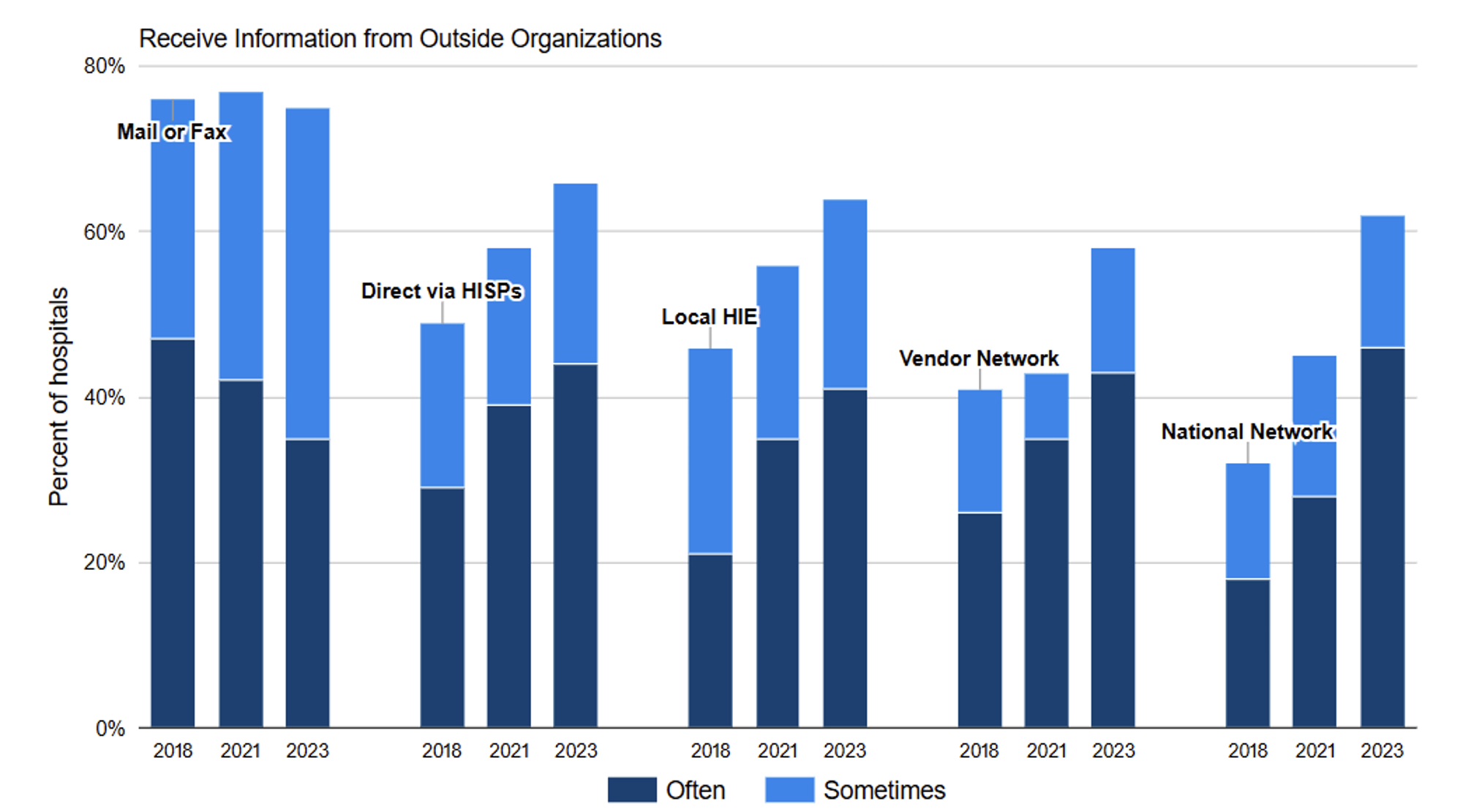
Recent data from the 2023 AHA IT Supplement Survey shows how hospitals are receiving patient information from outside organizations – hospitals that “often” received information by DSM jumped from 54% in 2018 to 73% in 2023 — providing clear and compelling growth metrics to illustrate the urgency of harmonizing modalities like DSM.”
Let’s dive into what DSM really is, why it matters, and how organizations like Concord Technologies are helping healthcare move forward — without leaving anyone behind.
What Is DSM?
Direct Secure Messaging (DSM), based on the Direct Standard® maintained by DirectTrust™, is a federally endorsed method for the secure, identity-verified exchange of clinical information. It is similar to encrypted email, but DSM goes further by operating within a trusted framework that requires validated sender and recipient identities, as well as policy-backed rules governing data sharing.
DSM is already widely supported by top EHR providers such as Epic and Athena, as well as many health information exchanges (HIEs). It allows providers, payers, and care coordinators to exchange structured data formats such as HL7, CCDA, or FHIR documents. This enables more than just secure transmission — it drives interoperability and automation.
Why DSM Matters in Healthcare Today
DSM Enables True Interoperability
Like fax, DSM is vendor neutral. It can be used across different software platforms, systems, and technology vendors without requiring proprietary integrations or dependencies. This standards-based approach allows healthcare stakeholders to exchange information freely across EHRs and organizations, using a common language and identity system. DSM acts as a bridge, not a silo. This is critical in a world where interoperability is no longer a buzzword — it’s a regulatory mandate and a clinical necessity. DSM aligns with ONC’s certification requirements for Transitions of Care, which reference the direct standard, and helps organizations operate within the Information-Blocking rules that require timely EHI exchange. And while policy sets the floor, adoption is growing: DirectTrust’s network carried 466M+ direct messages in Q1 2025².
The Problem: When Interoperability Fails
Before we explore how DSM addresses these challenges, it’s useful to consider what happens when interoperability fails during a care transition. Imagine a primary care provider refers a patient to a specialist for follow-up after a complex surgery. The referral is sent as a fax, but the patient’s medication list is left out, and the specialist’s office never receives the lab results because those were uploaded to a separate health portal not integrated with their EHR. The patient arrives for the appointment, but the specialist lacks the full context, leading to redundant tests, delayed care, and frustration for both patient and provider. This is a classic example of how fragmented communication channels and disconnected systems can break the continuity of care, undermining outcomes and efficiency.
Now compare how that process would have unfolded if the providers communicated via DSM:
- Everything Sent in One Secure Message: DSM allows the referral, medication list, and lab results to be bundled and sent electronically in real time.
- Delivered Directly to the Specialist’s Inbox: Using a verified Direct address, the specialist receives the message in their EHR or secure inbox — no need to chase down missing info
- Structured and Complete: DSM supports formats like C-CDA: structured and actionable full clinical summary — meds, allergies, labs, diagnoses— ready to review.
- Proof of Delivery: DSM provides a receipt and audit trail, so the sender knows it was received. No more guessing or relying on patients to confirm.
- Works Across All Systems: Whether the sender uses Epic, Cerner, or a small clinic EHR, DSM connects them. It’s the “poor man’s integration” that still gets the job done.
DSM Helps Close the Care Coordination Loop
DSM also enables closing of the care-coordination loop by automatically sending details about the specialist-patient encounter back to the primary care provider.
The Result: Better Informed Care, Less Friction. The specialist is prepared. The patient gets timely care. Everyone saves time and avoids frustration.
Here are some other situations where DSM can be applied:
- ADT (Admission, Discharge, Transfer) Notifications
- SNF (Skilled Nursing Facility) Care Coordination
- Public Health Reporting
- Transfer of Care
- Lab Result Routing
- Behavioral Health Coordination
DSM supports Efficiency and Automation
Today, most healthcare communication is locked in unstructured formats like PDFs or scanned faxes. These documents may be easy to send but are hard to use. They require manual handling by staff which may lead to error-prone data entry and delays.
DSM flips that script. By transmitting structured, identity-verified data, DSM comes structured as actionable information. It enables incoming messages to do more than just arrive into an inbox — they initiate workflows, populate systems, and alert the right teams at the right time.In this way, DSM acts like a healthcare information pipeline. Every message becomes part of a continuous, coordinated process that moves patient care forward, closes communication gaps, and reduces administrative overhead.The result?
- Accelerated care coordination from referral to treatment
- Less manual processing by staff and less rework
- More consistent, auditable and scalable processes
- The potential to lower operational costs by reducing administrative labor, redundant tests and process inefficiencies
Structured patient information enables automation. Automation delivers efficiency. And efficiency, at scale, drives down costs while improving the quality and reliability of care coordination.
Security & Compliance by Design
DSM builds security into both the transport and the trust model. Identities are verified and messages are cryptographically protected, helping organizations meet HIPAA Security Rule safeguards for transmission security and integrity while reducing operational risk. DSM provides measures including:
- Trusted senders and secure access: Only verified users with approved Direct addresses can send messages, helping prevent impersonation and making sure messages go to the right place.
- Privacy and protection: Messages are encrypted so they stay private and can’t be changed without detection.
- Rules for sharing: Built-in policies help control who can send and receive messages, and extra labels can guide how sensitive info is handled.
- Proof and tracking: Each message has a unique ID, making it easy to track delivery and investigate issues if needed.
- Works with your systems: DSM can carry structured data (like C-CDA) and fits into different workflows, even across different platforms and tools.
But Wait … What About Fax?
Here’s the reality: Digital fax isn’t going anywhere. It’s embedded in clinical and administrative workflows. It’s familiar, secure, universally available across disparate systems, it works and 85% of healthcare communication is still moved by fax¹
Yet, the landscape is changing. The demand for Direct Secure Messaging (DSM) is rapidly increasing as organizations recognize the need for more structured, secure, and interoperable data exchange. This surge calls not only for innovation in fax protocols, like adopting AI-powered Intelligent Document Processing (IDP) to streamline and enhance workflow efficiency, but also for robust integration with DSM.
The real challenge is fragmented and siloed communication channels. When communication happens across multiple, disconnected systems, digital fax in one place, email in another, portals in a third, gaps are created in the exchange of critical patient data. That can lead to unnecessary errors, increased administrative costs, and delays in patient care.
To truly improve care coordination, organizations must be prepared to receive and process both DSM and digital fax seamlessly. Only by supporting all modalities can we ensure information flows uninterrupted, enabling better patient outcomes and more efficient operations.
Digital fax continues to be a reliable modality for:
- Prior authorizations and claims
- Medical records requests
- Insurance forms
- Referral documentation
- Lab and radiology orders
- Prescriptions
Concord Technologies recognizes this, which is why we focus on unifying both Digital Fax and DSM with the ultimate goal of achieving Straight-Through Processing: the automated receipt, processing, and integration of documents and data directly into a system of record or workflow.
Concord’s Vision: One Platform, All Modalities
At Concord, we believe that the future of healthcare communication isn’t about choosing between DSM and digital fax — it’s about managing both through a unified, intelligent platform.
Here’s how we make that possible:
- Multi-modal Approach
Whether information comes in through fax or DSM our platform can receive it. This creates a single point of entry for all data types, reducing intake and triage bottlenecks.
- Intelligent Document Processing (IDP)
We apply AI to convert unstructured documents into structured data. Even faxes can be transformed into data-rich content that feeds workflows and automation. This structured information can then trigger downstream automation, seamlessly moving data into subsequent processes with minimal manual intervention.By enabling consistent processing of both structured and unstructured data, we help staff work more efficiently and ensure information gets where it needs to go — accurately and on time.
- Standardization
Standardization is essential for interoperability and the scalable adoption of AI, enabling patient information to be reliably routed, accurately analyzed, and efficiently responded to across systems. By aligning on trusted standards that help convert patient information into common formats, we ensure seamless communication and support organizations in maintaining compliance, continuity, and precision at every step.
- Workflow Integration
Data doesn’t live in a vacuum. Our platform connects with EHRs, payer systems, and care management tools, so that inbound and outbound communication are part of an end-to-end, straight through process.
- Flexibility for Any Tech Stack
Understanding that healthcare organizations rely on a range of technologies, Concord’s platform is designed for maximum flexibility. We integrate with legacy systems, cloud-based applications, and everything in between — enabling organizations to modernize at their own pace, without forcing disruptive changes to their existing tech stack.
A Future of Choice and Coordination
DSM represents a massive step forward in healthcare communication. It provides the structure, security, and interoperability that the industry has long needed. Importantly, its adoption doesn’t require abandoning what already works.
By embracing DSM alongside existing modalities like digital fax, healthcare organizations can evolve at their own pace. No need to sacrifice continuity, reliability, or compliance. And as the industry moves toward greater national interoperability, frameworks like TEFCA and emerging directory networks will play a critical role in unifying trusted exchange. Concord’s approach is designed to align with these developments, ensuring our customers are ready for what’s next.
With Concord, that future is already here. We help you:
- Leverage the strengths of Digital Fax while unlocking the benefits of DSM
- Close the loop on fragmented patient information exchanges
- Build smarter workflows with structured, actionable data
- Stay compliant without compromising flexibility
Track and audit communication exchange between your health partners
Final Thoughts: It’s Not About Channels — It’s About Continuity
In the end, the real value isn’t in the medium. It’s in the movement and management of information across the care continuum. Every handoff, whether it’s between primary care, specialists, labs, or post-acute providers, depends on timely, complete information to avoid errors and delays in care. DSM offers a powerful new channel, but the bigger picture is about orchestrating all your communication under one intelligent system.
That’s what Concord does. We help you make every message — digital fax, DSM, or otherwise — part of a smarter, faster, more efficient healthcare process.
Let’s unify communication. Let’s streamline coordination. And let’s do it without leaving anyone behind.
Sources:
¹ IJSAT, Enhancing Efficiency in Healthcare: 2025
²DirectTrust.org – “The Continued Growth of Direct Secure Messaging”