
Document, Data, and Fax Automation for Interoperability

Get your healthcare information where it needs to go. Request a workflow assessment, today.

Connect everything–your staff, health partners, and healthcare information

Concord Connect™ offers flexible, secure integrations to enable straight-through processing of healthcare data and documents directly into EHRs and back-office systems — accelerating access to the critical information your staff needs to inform care, improve delivery, and support reimbursement.

EHR Integration

Concord’s Integration Engine enables straight-through processing of healthcare data and documents from fax, email, DSM and more directly into most EHRs with minimal staff involvement.
No Code Integrations

Easily get documents and data where they need to go through simple measures such as SFTP, HTTPS, Fax Assist network routing, and Outbound Folder Fax.

Open APIs

Customers receive access to a robust suite of APIs,
developer tools and support materials to simplify the process  of extending your platform  with Concord’s suite of solutions.

Salesforce

Send and receive critical information, generate documents and obtain signatures all within your Salesforce CRM

Technology Partner Integrations

Concord partners with top tech leaders to streamline document workflows and improve interoperability in healthcare.

Custom Integration

Have custom integration requirements? We’re up
for the challenge.
Let’s talk about it.

Concord’s Integration Engine — fast, accurate
document delivery to EHRs.

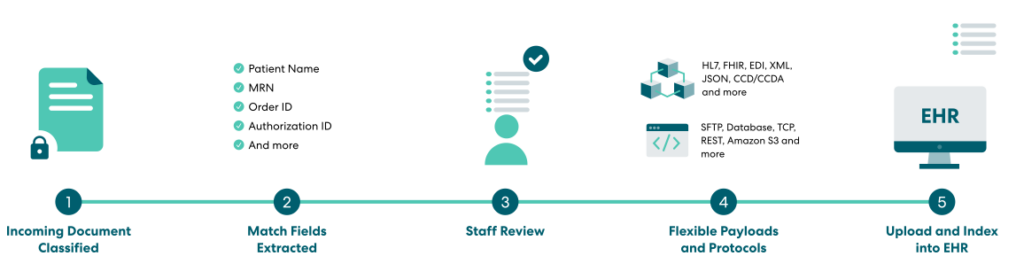
Concord’s Integration Concord’s Integration Engine enables straight-through processing of documents and data to the correct patient, encounter, or workflow within their EHR or system of record. The platform integrates healthcare data  into patient records with robust support for HL7, FHIR, CCD/CCDA, and DICOM, helping ensure patient information is delivered correctly, quickly and readily accessible within the patient record.
Frequently Asked Questions

Do I need technical staff or developers to set up integrations?
It depends on your needs. For standard integrations, we offer no-code options like SFTP, HTTPS, and folder-based routing that your IT team can configure without custom development. For EHR integrations and custom workflows, implementation support is provided. If you want to build custom applications or extend functionality, we also provide APIs and developer documentation.
Yes. The integration engine can automatically identify document types and route them to appropriate workflows within your EHR. For example, lab results can go to one queue, referrals to another, and patient correspondence to a third. This intelligent routing helps ensure documents reach the right department or staff member without manual sorting.
The integration engine uses patient identifiers from incoming documents (like MRN, date of birth, or other demographics) to match against your EHR’s patient database. When a match is found with high confidence, documents are automatically filed. When there’s ambiguity or no match, the system flags it for staff review rather than guessing, which prevents the dangerous situation of documents landing in the wrong patient’s chart.
Most modern EHRs can still integrate through standard protocols like HL7 or FHIR, even if they’re not specifically listed as technology partners. We also offer custom integration development for unique requirements. The best approach is to discuss your specific EHR and workflow needs to determine the most appropriate integration method.
Yes, that’s one of the main benefits of a unified integration approach. Whether a document arrives via digital fax, Direct Secure Messaging, email, or other channels, the integration engine processes them through the same workflow and routing logic. This means you don’t need separate systems or processes for each incoming channel.
Implementation timelines vary based on your EHR, the complexity of your workflows, and how many document types you’re routing. Simple integrations with well-supported EHRs can often be completed in a few weeks. A workflow assessment can provide a more accurate timeline for your specific situation.
Straight-through processing means documents and data automatically route to the correct patient chart, encounter, or workflow in your EHR without manual sorting or filing. Instead of staff members opening each fax or message and manually attaching it to a patient record, the system uses patient identifiers to place documents in the right location automatically, reducing manual work and the risk of misfiling.

See Concord Connect in action.

Scroll to Top